RCDs, often called safety switches, are now standard in Australian homes. They’re designed to protect people by cutting the power instantly if a fault occurs. Here’s what you need to know about how they work, why they matter, and what to do if your home isn’t protected.
Quick Summary
- RCDs (Residual Current Devices) protect people by cutting power within milliseconds if electricity leaks to earth.
- They help prevent electrical shocks and fires, reduce fire risk, and protect appliances.
- RCDs are different from circuit breakers – RCDs protect people, breakers protect wiring.
- In Australia, RCDs are mandatory in homes, rentals, and workplaces.
- RCDs must be installed and tested by a licensed electrician to meet current safety standards.
What is an RCD?
An RCD, or Residual Current Device, is commonly known as a safety switch. It’s a life-saving device fitted to protect people rather than just the wiring in your home.
An RCD works by monitoring the flow of electricity through a circuit. In normal conditions, the current leaving through the live wire is the same as the current returning through the neutral. If there’s a problem – such as electricity taking an unintended path through a person or faulty electrical equipment – the RCD detects the imbalance and shuts off power in milliseconds.
This rapid cut-off can prevent serious electrical shocks and fires. That’s why RCDs are now mandatory in homes across WA and throughout Australia.
Why is an RCD important?
RCDs are one of the most effective safeguards you can have in your home. Unlike fuses and circuit breakers, which only protect wiring and equipment, RCDs are designed to protect people – and they do it fast.
- Prevent electrocution – If you accidentally touch a live wire or faulty appliance, the Residual Current Device will trip and cut power within 30 milliseconds, stopping a potentially fatal shock.
- Reduce fire risk – Faulty wiring and damaged appliances can overheat and spark fires. An RCD quickly shuts off the current before it has a chance to cause serious damage.
- Protect appliances – By disconnecting power during a fault, an RCD can reduce the chance of costly damage to your household electronics and appliances.
- Meet Australian standards – RCDs are mandatory in homes, rentals, and workplaces across WA and the rest of Australia, ensuring every property has a baseline level of protection.
- Peace of mind – With properly installed and tested RCDs, you know your family, your home, and your appliances are safer every time you turn on a switch.
How Does an RCD Work?
An RCD works by constantly monitoring the flow of electricity through a circuit. In normal conditions, the current leaving through the live wire should always equal the current returning through the neutral wire.
If something goes wrong – for example, a person touches a live wire or an appliance develops a fault – some of that current leaks to earth. This imbalance is what the RCD is designed to detect.
The moment it senses even a small difference, the RCD reacts in less than 30 milliseconds, cutting the electricity supply to that circuit. That speed is what prevents serious injury, death, or fire.
To put it simply:
- Normal conditions – Current in and current out are equal.
- Fault condition – Current leaks (through a person, appliance, or damaged wiring).
- Residual Current Device response – Detects the leakage and instantly disconnects power.
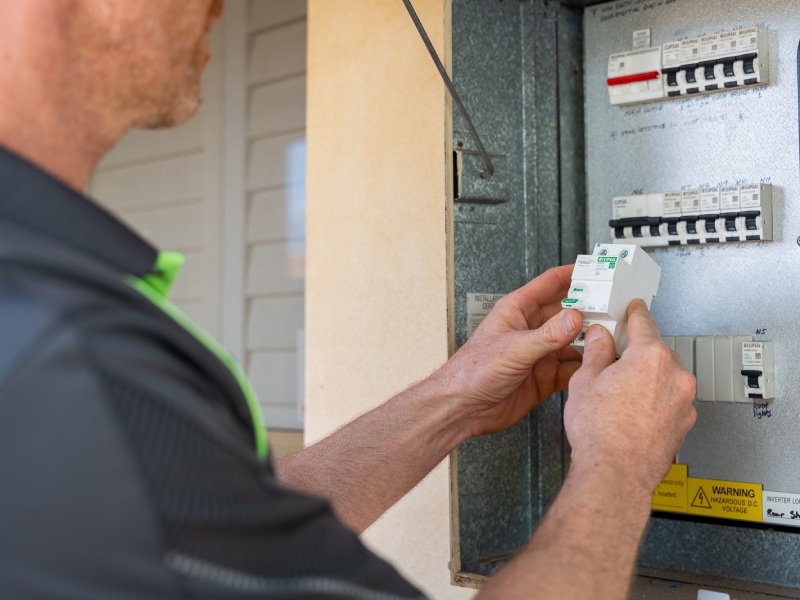
This is why every RCD in your switchboard has a test button (labelled “T”) – it allows you to check that the device is still tripping as it should.
Where Are They Used?
RCDs are fitted anywhere people need protection from electric shock – which means just about everywhere electricity is used.
- Homes – In WA and across Australia, safety switches are required on all power and lighting circuits in residential properties. They’re fitted in your switchboard and protect every power point and light connected to that circuit.
- Workplaces – Building sites, workshops, and other high-risk areas must use RCDs, especially where tools and equipment are portable and more prone to damage.
- Rental properties – Landlords are required to ensure RCDs are installed before a property can be leased.
- Renovations and upgrades – Any electrical upgrade or renovation must include compliant RCD protection before the work is signed off.
Wherever electricity is used, RCDs are now the standard line of defence – protecting families, workers, and properties.
RCD vs Circuit Breakers – Are They the Same?
RCDs and circuit breakers are not the same, though both play an important role in electrical safety. They serve different purposes and are designed to work alongside each other.
- RCDs (safety switches) – Monitor the flow of electricity and trip when there’s an imbalance, such as current leaking to earth. This protects people from electric shock and reduces the risk of fire.
- Circuit breakers – Trip when too much current flows through a circuit, such as during an overload or short circuit. This protects the wiring and appliances from damage.
On your switchboard, you can tell them apart easily: RCDs have a test button (marked “T”), while circuit breakers do not.
Quick Comparison: RCD vs Circuit Breaker
| Feature | RCD (Safety Switch) | Circuit Breaker |
| Purpose | Protects people from electric shock | Protects wiring and electrical equipment from overload or short circuit |
| Detection Method | Trips when there’s a current imbalance | Trips when current exceeds safe limits |
| Response Time | Very fast – within milliseconds | Fast – but based on current level |
| Test Button | Yes – labelled “T” | No |
| Protection Focus | Personal safety and fire prevention | Electrical system and installation safety |
What Happens If You Aren’t Protected?
Homes without RCDs are at a higher risk of electric shock and electrical fire. That’s why Australian regulations require safety switches to be fitted in all new homes, renovations, and most existing dwellings. In WA, at least two RCDs must be installed on residential switchboards to cover both power and lighting circuits.
If your home doesn’t have RCD protection, or you’re unsure whether your switchboard is compliant, it’s best to have it inspected by a licensed electrician. Upgrading an older switchboard to include RCDs not only meets legal requirements but also improves the overall safety of your electrical system.
RCD Installation
RCDs must be installed by a licensed electrician. At Limelight Electrix, we install safety switches that meet current Australian Standards, ensuring your home is compliant and your family is protected. With every installation, we also carry out a free safety inspection of your electrical system.
RCD Testing
Like any device, RCDs need to be tested to make sure they’re still working correctly. Each safety switch has a test button (marked “T”), which should be pressed every three months. This simulates a fault and checks that the switch trips as it should.
If your RCD doesn’t trip when tested, or if you’re unsure, contact us. We also provide professional RCD testing as part of our electrical inspections to confirm your devices are operating properly.
Conclusion
RCDs, or safety switches, are one of the most important parts of your home’s electrical system. They protect people from electric shock, reduce the risk of fire, and are required by law in WA homes.
If you’re unsure whether your switchboard has working RCDs, it’s worth having it checked. At Limelight Electrix, we install, test, and service RCDs to Australian Standards, with upfront pricing and a free safety inspection included in every job.
Contact us today to book an inspection or upgrade your switchboard, and keep your home safe with reliable RCD protection.
Frequently Asked Questions
What does RCD stand for?
RCD stands for Residual Current Device. It’s also commonly called a safety switch.
How does an RCD work?
An RCD monitors the current flowing in and out of a circuit. If it detects a difference – such as electricity leaking to earth – it trips and cuts the power within milliseconds.
Are RCDs mandatory in Australia?
Yes. Australian regulations require RCDs to be installed in all new homes, renovations, and most existing dwellings. In WA, at least two RCDs must be fitted on residential switchboards to cover power and lighting circuits.
Is a circuit breaker the same as an RCD?
No. A circuit breaker protects wiring and electrical equipment from overload or short circuit, while an RCD protects people from electric shock. Both are needed for a safe electrical installation.