Jumped in the shower this morning and got hit with cold water? Your hot water system has stopped working, and now you need to figure out who to call — fast.
The confusion is understandable. Hot water systems contain both plumbing and electrical components, and calling the wrong trade first can waste time and money. This guide cuts through the uncertainty so you can make the right hot water repair call based on what is actually wrong with your system.
Quick summary
- Call a plumber if you can see water leaking, notice rust or discolouration, or have low hot water pressure.
- Call an electrician if the system has no power, the circuit breaker keeps tripping, the water is only lukewarm, or the heating element has failed.
- Call both if you have a leaking tank combined with an electrical fault — which is more common than you might expect.
- If you have a gas hot water system, you need a licensed gas fitter, not a general plumber or electrician.
- When in doubt, start by checking your circuit breaker and pressure relief valve. These two checks often reveal the answer without calling anyone.
How a hot water system actually works
Before knowing who to call, it helps to understand what type of system you have.
Most Perth homes run on one of the following:
- Electric storage systems — a tank that stores and heats water using electric heating elements
- Gas storage or instantaneous systems — heated by a gas burner rather than electricity
- Heat pump systems — use ambient air to heat the water, with electrical components controlling the process
- Solar hot water systems — heated by roof-mounted collectors, usually with an electric or gas booster
The type of system you have directly affects which trade handles the repair. Electric systems involve both licensed electricians (for heating elements, thermostats, wiring, and circuit issues) and plumbers (for the tank, pipes, valves, and connections). Gas systems involve plumbers and licensed gas fitters for almost everything.
Check these two things before calling anyone
Before picking up the phone, take two minutes to check the following:
- Check the circuit breaker
- Test the pressure relief valve
Either issue can be the entire cause of your hot water failure — and may resolve without a callout at all.
1. Check the circuit breaker
Go to your switchboard and look for a tripped breaker. If one is in the middle or “off” position, try switching it back to “on.”
- If it stays on — your hot water system should start heating. Allow at least 1 to 2 hours for many electric storage tanks to reheat before testing the taps, and longer for larger or off-peak systems.
- If it trips again immediately — there is likely a fault in the system. Do not keep resetting it. This is a job for an electrician.
- If everything looks fine at the switchboard — the issue is probably not electrical at the circuit level, so look further.
2. Test the pressure relief valve
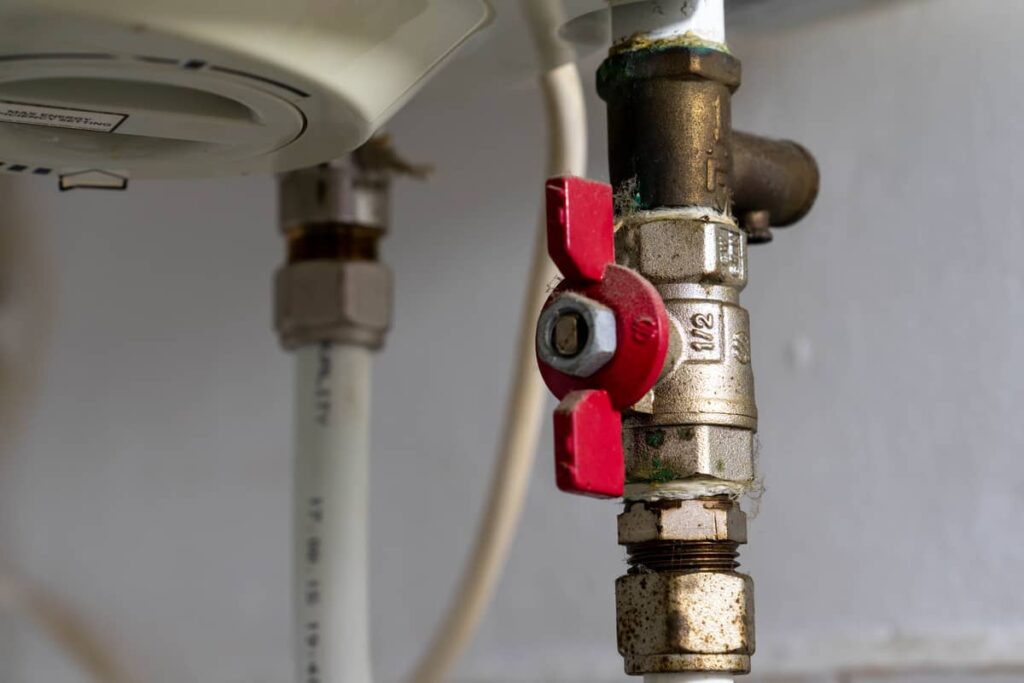
The pressure relief valve (sometimes called the T&P valve or PRV) is a safety device typically located on the side of your tank, near the bottom third. It has a small lever you can lift to test it.
- Lift the lever briefly. Water should flow out of the overflow pipe.
- If no water flows — the valve may be stuck, or the tank may need to be refilled. A plumber can assess this.
- If water flows but then keeps running well after the heating cycle — the valve may be faulty or the system may be under too much pressure. Call a plumber.
- If there is water pooling under the tank — this is a leak. Call a plumber.
When to call a plumber
Plumbing faults with hot water systems relate to the tank itself, pipes, valves, and water connections. These are the visible, water-related problems.
Call a plumber if you notice:
- Water leaking from the tank, pipes, or fittings — puddles under the system or damp patches nearby are a clear sign
- Low hot water pressure — when hot water is noticeably weaker than cold, the issue is usually in the tank or on the hot water side of the pipes
- Rusty or discoloured water — brown or reddish hot water typically indicates the tank is corroding from the inside
- No water flowing at all from hot taps — can indicate a blockage, failed valve, or empty tank
- The pressure relief valve is continuously releasing water well after the heating cycle — the valve itself or the tank pressure may need attention
- A sulphur or metallic smell — often caused by a failing anode rod inside the tank, allowing bacterial build-up or corrosion
Why this matters
A leaking or corroding tank is not just inconvenient — it can cause serious water damage to your home if left unattended. Plumbing faults like these also reduce how efficiently the system heats water, which drives up your energy bills even before the system fully fails.
When to call an electrician
Electrical faults relate to the components that power and control your hot water system — the heating elements, thermostat, wiring, and the circuit that feeds the unit.
Call a licensed electrician if:
- The circuit breaker keeps tripping when you reset it — a persistent trip means there is a fault in the circuit or the system is drawing too much current
- The system has no power at all and the circuit breaker appears fine — there may be a wiring fault, failed safety switch, or issue at the unit itself
- The water is only lukewarm, not hot — this is one of the most common signs of a failed or failing heating element, a faulty thermostat, or in some cases a tempering valve issue
- The system runs on off-peak power and never heats up — the off-peak relay switch or timer may have failed
- You can see damaged, exposed, or burnt wiring near the unit — do not touch this, switch the system off at the switchboard and call immediately
- You are upgrading or replacing the system — in WA, electrical and plumbing work each require their own licensed trade. An electrician handles the wiring and connection to the circuit; a plumber handles the tank, pipework, and valve connections. Both are required for a full installation.
Why this matters
Electrical faults in hot water systems can be easy to misread. A water heater that produces only lukewarm water does not always look like an electrical problem, but in many cases the heating element or thermostat is the direct cause. In some systems, a tempering valve issue can also be involved. Calling a plumber first in this situation can mean two callouts instead of one.
The symptom-by-symptom breakdown
| Symptom | Most likely cause | Who to call |
| No hot water at all | Tripped circuit, failed element, empty tank | Check switchboard first; electrician if electrical, plumber if tank |
| Water only lukewarm | Failed heating element, faulty thermostat, or possibly a tempering valve issue | Electrician or plumber, depending on diagnosis |
| Circuit breaker keeps tripping | Electrical fault in system | Electrician |
| Water leaking from the tank | Cracked or corroded tank, failed fitting | Plumber |
| Low hot water pressure | Blockage, valve issue, or sediment | Plumber |
| Rusty or brown hot water | Corroded tank, failing anode rod | Plumber |
| Rotten egg smell in hot water | Failed anode rod, bacterial build-up | Plumber |
| Pressure relief valve releasing continuously well after heating | Excessive pressure or faulty valve | Plumber |
| No power to the unit at all | Wiring fault, blown fuse | Electrician |
| Gas system not heating | Burner or gas supply issue | Licensed gas fitter |
| Solar booster not working | Electrical booster fault | Electrician |
| Replacing or upgrading the system | New installation wiring | Electrician (plus plumber for connections) |
What if you need both?
It happens more often than people expect. An electric storage hot water system that has both a leaking tank and a failed heating element needs a plumber and an electrician — they address different parts of the system.
In cases like this, the most practical starting point depends on what you can see:
- If water is leaking — call a plumber first. They will assess the tank and connections, and can tell you if an electrical fault is also contributing to the problem.
- If the issue is purely no power or lukewarm water with no visible leak — call an electrician first. They can assess the electrical side and advise if a plumber is also needed.
The key is not to wait. A leaking tank can cause significant water damage quickly, and a persistent electrical fault can shorten the life of the system or create a safety hazard.
The definitive answer: who do you call?
Here is the plain answer:
Call a plumber if the problem involves water — leaks, pressure, discolouration, tank condition, or valves.
Call an electrician if the problem involves power — no power to the unit, tripping circuits, lukewarm water from a failed element or thermostat, or any wiring issue.
Not sure? Check the circuit breaker first. If it is fine and there is no visible leak, common causes of a completely failed electric hot water system include a failed heating element, a faulty thermostat, an off-peak control issue, or a wiring fault — which usually points to the electrical side of the system.
Need an electrician for your electric hot water system in Perth?
At Limelight Electrix, we repair and replace electric hot water systems across Perth. Whether it is a failed heating element, a thermostat fault, a tripping circuit, or a full system replacement, we handle the electrical side of the job properly — with upfront pricing and a free electrical safety inspection included.
We can help with:
- Diagnosing a hot water system that is not heating
- Replacing failed heating elements and thermostats
- Inspecting wiring and circuits connected to your hot water unit
- Connecting new electric hot water systems
- Advising on off-peak tariffs and system upgrades
View our electric hot water system service →
Or call 1300 880 761 to book an assessment.