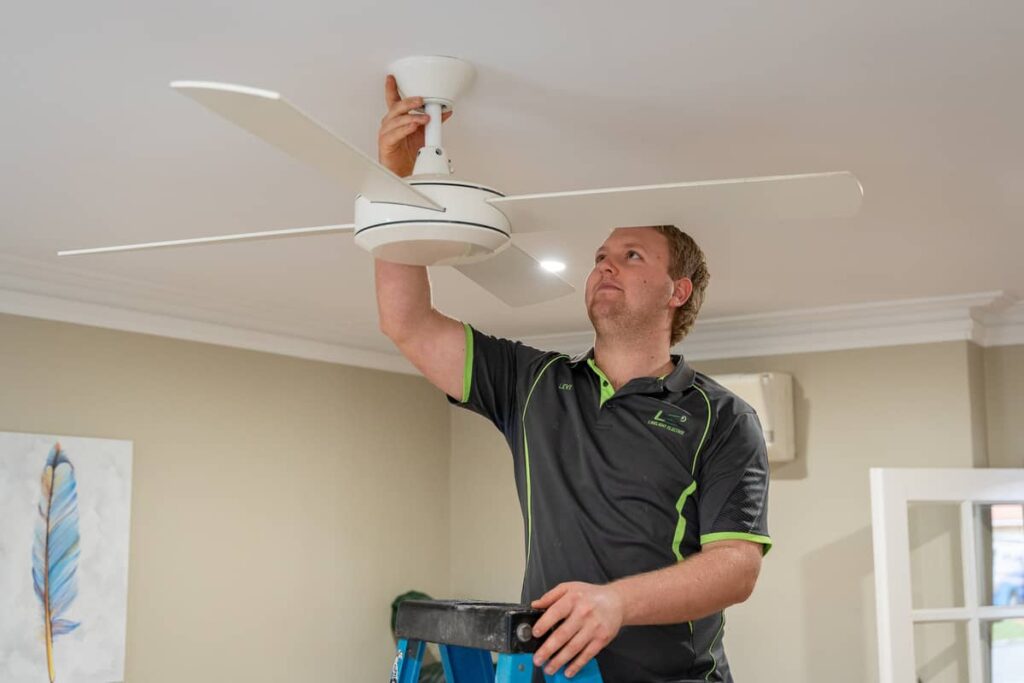
A ceiling fan that cuts out, wobbles, or stops working on certain speeds is frustrating, especially in a Perth summer.
The real question is whether it is worth fixing, or whether you are better off replacing it entirely. The answer usually comes down to a few things: the age of the fan, what the fault actually is, and how much a ceiling fan repair will cost compared to a new unit.
This guide breaks it down clearly so you can make the right call.
Quick summary
- Repair the fan if it is relatively new, the issue is minor, and the fix is straightforward.
- Replace the fan if it is older, has a failed motor, is physically damaged, or keeps developing problems.
- If your fan is more than 10 years old, that does not always mean it must be replaced, but it is a good sign that you should look more closely at whether a repair still makes sense.
Repair vs replace: quick comparison
| Situation | Repair is usually worth it | Replacement is usually the better option |
| Age of the fan | The fan is relatively new and has otherwise been reliable | The fan is older, faults are becoming more frequent, or parts are harder to source |
| Type of fault | Minor wobble, wiring issue, switch fault, controller issue, or blade balancing problem | Failed motor, repeated overheating, cracked blades, or ongoing faults |
| Cost | The repair is modest and likely to restore reliable use | Repair costs are getting close to the cost of a new fan |
| Performance | The fan still works well once the issue is fixed | The fan is noisy, inefficient, or underperforming compared to newer models |
| Safety | No signs of overheating, burning, or structural damage | Burning smell, tripping circuit, heavy wobble, or visible damage |
Signs the problem is worth repairing
Not every faulty ceiling fan needs to be replaced. Many faults come from outside the fan itself, such as wiring, mounting, or installation quality, rather than internal failure.
Repair usually makes sense when:
- The fan wobbles or rattles but the motor runs fine
- The fan cuts out intermittently, which may point to a wiring or switch fault
- The remote or wall controller has stopped responding
- The fan runs on some speeds but not others
- The blades are unbalanced but undamaged
These types of faults are often repairable. A licensed electrician can check whether the issue is in the fan itself or in the wiring and controls connected to it.
Why this matters
Wobbling, noise, and speed issues are often caused by poor installation rather than a failed fan. Getting the fan assessed properly before replacing it can save you the cost of a new unit.
Signs it is time to replace the fan
Some problems suggest the fan is nearing the end of its useful life. At that point, continuing to repair it can end up costing more than it is worth.
Replacement usually makes more sense if:
- The fan is older and faults are becoming frequent
- The motor hums but the fan will not spin
- The motor overheats during normal use
- The blades are cracked, warped, or visibly damaged
- The fan wobbles persistently and cannot be corrected through adjustment
- Repair costs are getting close to the cost of a new unit
A failed motor, a fan that hums without spinning, or visible structural damage are all strong signs that replacement is likely to be the safer and more cost-effective option.
Why this matters
Using a fan with a failing motor or damaged blades is not just inconvenient. It can also be a safety issue. A fan that is not secure or structurally sound should not be ignored.
The cost rule of thumb
Before agreeing to any repair, get a clear quote.
A good rule of thumb is that if repair costs are around half the price of a new fan, replacement is usually the better value. You get a new unit, a manufacturer warranty, and the benefits of newer technology without the risk of paying to fix one problem only for another to show up soon after.
This is often even more relevant with older fans, where parts can be harder to source or older remotes and controllers are no longer compatible.
What about energy efficiency?
Older ceiling fans often use AC motors, which usually draw more power and are generally louder than modern DC alternatives.
Newer DC motor ceiling fans typically use less electricity and run more quietly. If your current fan is older, replacing it with a modern DC model may help reduce energy use and lower running costs over time, especially in Perth homes where fans can run for long periods through summer and autumn.
It is worth factoring that into your repair versus replace decision.
Why installation quality matters
Many ceiling fan problems have nothing to do with the fan itself.
Poor mounting, incorrect wiring, or blade misalignment during installation can cause noise, vibration, and early wear. Before deciding a fan is faulty, it is worth having a licensed electrician check whether the installation is the real cause.
This is particularly relevant for:
- Fans that have wobbled or rattled since the day they were installed
- Fans that trip the circuit or behave inconsistently
- Fans where the remote or speed settings have never worked properly
Getting the installation right, whether for a repaired or replacement fan, plays a big part in how well it performs and how long it lasts.
What we check when assessing a ceiling fan
When we inspect a ceiling fan that is not working properly, we do not just look at the fan in isolation.
We typically check:
- The mounting bracket and ceiling connection for security
- Blade balance and alignment
- Wiring condition and connections at the fan and switch
- Motor behaviour under load
- Remote or controller compatibility
- Whether the circuit is suitable for the fan
This helps us work out whether the fault is repairable, whether it is an installation issue, or whether the fan is better off being replaced.
When to stop using the fan immediately
Do not keep using a ceiling fan if you notice:
- A burning smell coming from the motor housing
- Visible scorch marks or discolouration
- Grinding or crackling sounds
- The circuit trips when the fan is switched on
- Excessive wobbling or movement that makes the fan feel unsecured
Switch it off and leave it off until it has been assessed by a licensed electrician. A fan that is overheating or not properly secured is a hazard, not just an inconvenience.
Need a ceiling fan assessed or replaced in Perth?
We handle ceiling fan repairs and replacement installs across Perth, including supply and installation of new units where needed.
What we can help with:
- Diagnosing a ceiling fan that is not working properly
- Repairing wiring, switches, and controller faults
- Replacing old or failed fans with a new, energy-efficient model
- Installing DC motor ceiling fans for quieter, lower-cost running
- Safety checks on existing fans that wobble or trip the circuit
Every job comes with upfront pricing and a free electrical safety inspection, so you know the fan and the wiring behind it are safe.
View our ceiling fan installation and repair service or call 1300 880 761 to book an assessment.